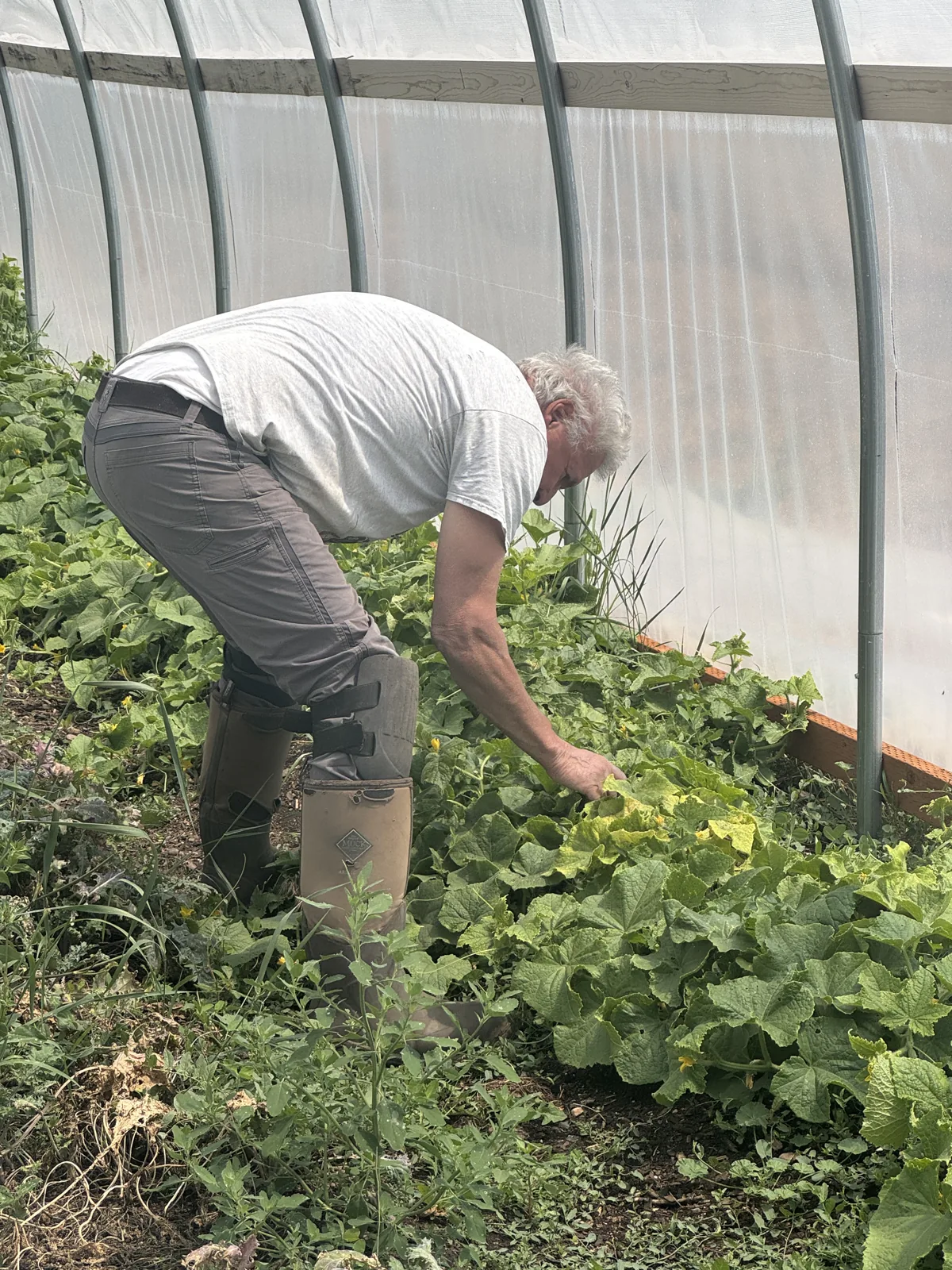
01 / BACKGROUND
From Investment Banking To Farming
Stephen saw an unexpected similarity between banking and agriculture.
Both involve clients.
Both involve relationships.
Both require understanding what another person wants and knowing how to negotiate around problems.
These skills became central to how he approached the farm.
KEY INSIGHT
New farmers do not necessarily enter agriculture empty-handed.
Knowledge can come from outside farming and still reshape how a farm operates.
02 / MARKETS
One Buyer Instead Of Hundreds
Stephen deliberately avoids making farmers markets the center of his sales model.
Instead, the farm supplies produce directly to restaurant buyers in nearby resort communities. Produce is packed in larger quantities and delivered to a regular customer rather than displayed in small bunches for individual shoppers.
As Stephen put it:
“Why would I want to spend all that time sitting in a parking lot when I could spend that time here instead?”
KEY INSIGHT
Where food is sold determines more than price.
It also determines how a farmer spends time.
03 / LOCAL FOOD
From Arugula To The Resort Table
At a nearby resort event, Stephen described chefs serving salads while emphasizing the local arugula they were using.
The moment captures the market he is trying to build: not anonymous produce entering a wholesale chain, but food whose origin remains visible to the buyer and diner.
His version of direct sales is different from Red Acre’s CSA model.
The relationship is not primarily farm-to-household.
It is farm-to-restaurant.
RESEARCH QUESTION
How many different forms can “local food” take?
04 / POLICY
When Policy Becomes Infrastructure
Government support appears very concretely at Splendor Valley.
Stephen described receiving roughly $20,000 toward a walk-in refrigerator used to keep produce cold before delivery.
He also discussed the instability of agricultural grant priorities. Funding criteria can shift, sometimes encouraging farms to reshape their business around what programs are willing to support.
Stephen said his own business direction happened to align with the available funding rather than being redesigned for it.
KEY INSIGHT
Policy does not enter agriculture only through regulation.
Sometimes it becomes physical infrastructure.
05 / CLIMATE
Farming Beside A Ski Economy
Splendor Valley operates in a high-altitude environment with a relatively short growing season.
Frost can arrive unexpectedly, and production slows during the colder months.
At the same time, the surrounding economy depends heavily on ski tourism.
After a winter with relatively little snow, Stephen began thinking more seriously about agritourism—farm visits, children’s activities, and outdoor experiences that could complement the region’s ski economy.
RESEARCH QUESTION
What happens when climate affects both the farm and the economy surrounding it?