01 / FARMING PHILOSOPHY
A Farm As A Living System
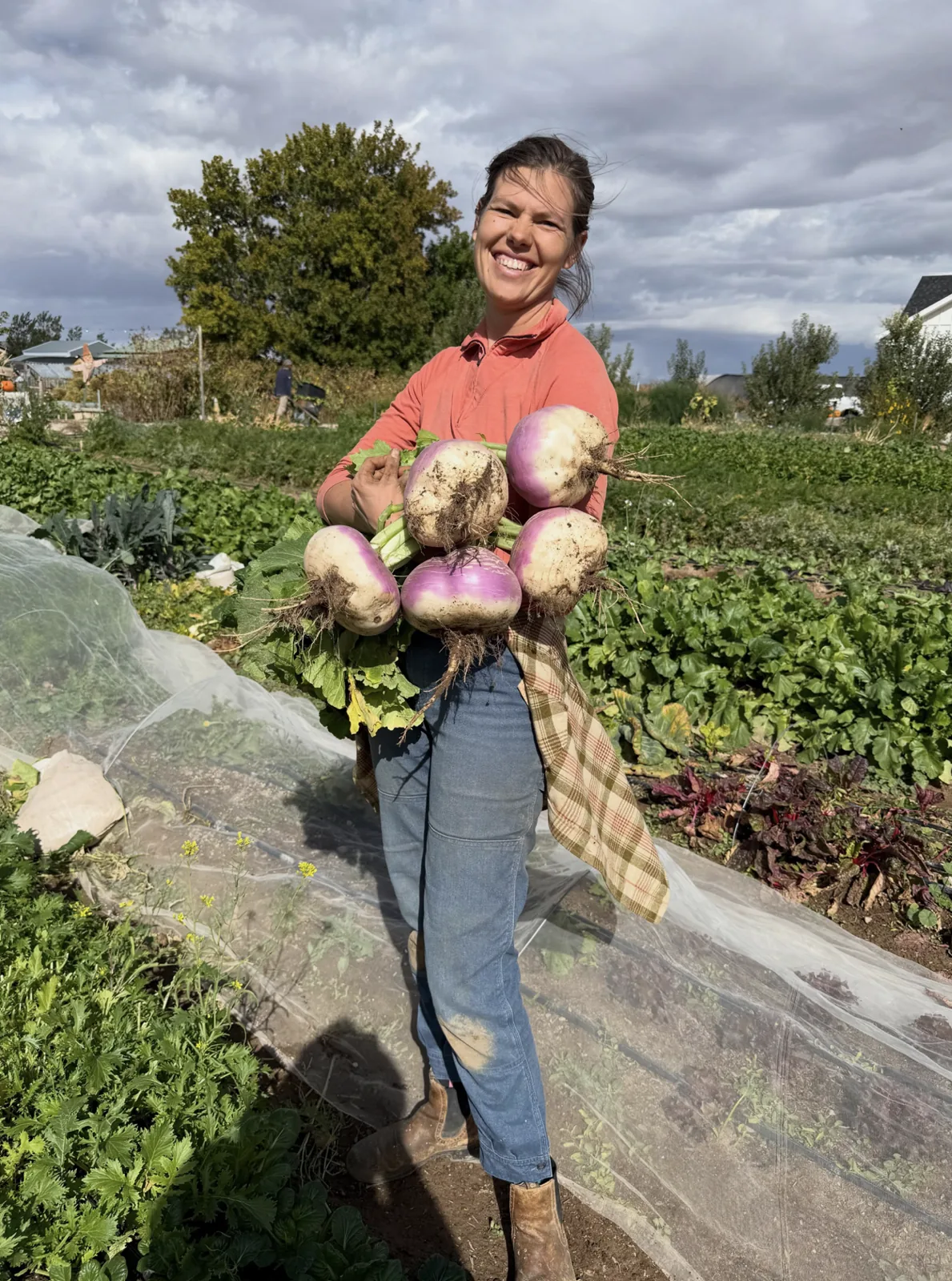
Sara describes biodynamic agriculture as an approach in which soil, animals, crops, fertility, and farm management are understood as parts of one interconnected organism.
At Red Acre, animals contribute organic material to compost. Crop rotation, intercropping, cover crops, and biodiversity form part of the fertility system, while drip irrigation is used to deliver water more precisely.
For Sara, sustainability is not one technique or certification.
It is the relationship among many parts.
KEY INSIGHT
Sustainable agriculture can be understood less as a checklist of practices than as a system of relationships.
02 / COMMUNITY
More Than A Vegetable Box
Red Acre operates what Sara describes as a full-diet CSA.
Members commit for a full year and receive food across all fifty-two weeks. Rather than simply collecting a predetermined box of vegetables, participating households come to the farm and take food according to their needs.
The structure reflects a particular idea of community-supported agriculture: not simply purchasing food from a farm, but building an ongoing relationship with one.
KEY INSIGHT
A market model can also express a social philosophy.
03 / LAND
When Farmland Becomes A Retirement Plan
Sara does not describe farmers who sell land to developers as people who simply stopped caring about agriculture.
A farmer may work for decades without building a conventional retirement fund. The next generation may not want—or be able—to continue farming. Meanwhile, development can make agricultural land worth far more as real estate than as a working farm.
Under those conditions, selling land may become the most financially viable retirement option.
RESEARCH QUESTION
What happens when the economic value of farmland depends on no longer farming it?
04 / WATER
The Paradox Of Water Efficiency
Red Acre relies on groundwater from the local aquifer.
Sara described an apparent contradiction: more precise irrigation can reduce immediate agricultural water use, while older flood-irrigation systems may have allowed more excess water to infiltrate downward.
For her, the question is not simply how much water agriculture uses, but how water moves through the entire valley.
KEY INSIGHT
Efficiency depends on the scale at which it is measured.
A system can become more efficient at the field level without necessarily resolving a larger groundwater problem.
05 / POLICY
From Farmer To Advocate
Sara’s experience as a first-generation and direct-market farmer eventually brought her into state-level agricultural policy.
She felt that regulations were often shaped around larger or more conventional agricultural models and did not always reflect the realities of small producers.
After working successfully on one state bill, she and others developed a nonprofit that, according to her account, went on to participate in more than twenty Utah state bills affecting small agriculture and direct-to-consumer production.
“Someone needed to do the work.”
RESEARCH QUESTION
Whose experience reaches the room where agricultural policy is written?
06 / WHY SHE STAYS
“Bumps In The Road”
Near the end of the conversation, Sara described farming setbacks as:
“bumps in the road”
When farming feels like a mission or a calling, she explained, difficulty becomes another problem to solve rather than necessarily a reason to leave.
Her answer brings the conversation back from policy and systems to the individual.
Sometimes agriculture continues not because it is easy or maximally profitable, but because the work still feels meaningful.